First of all, a Signal Officer never becomes a general in the Army. He has to compete with the Navy and Air Force for a position at GHQ. He can never be a 3-star, much more the Chief-of-Staff. The best he can get is a 2-star, if he has still time when the J6 retires. Kaya madalas na mapagsabihan kami, nag Signal kasi kayo!
Likewise in the Signal Corps, we are only remembered when problem arises and never during normal times. We are castigated whenever there’s no radio contact, no dial tone, poor internet connection, bad sound systems, and other shortcomings. Communications is the easy alibi out for troop leaders when operation fails. The blame is on us! But when things are going well, even extraordinarily, people are unaware about our existence and diligent efforts. Ganyan sa Signal!
So in the Signal Corps, the gauge, for a “job well done” for Signal officers, is when commanders do not tend to notice them anymore. It means there is no problem! All equipment are working well. Pero, bakit palagi pa rin kami last priority sa bigayan ng grasya. Nag Signal kasi!
In the Signal Corps, we had our defining moment. I believe you will all agree with me. After our hosting of the Asean Armies Rifle Meet, better known as AARM, in 2008, Chief of Armies and participants of the Asean Nations were all praises in the way we handled the competition (I was able to validate this when I became the Officer-in-Attendance for General Neo Kian Hong of Singapore last year when he visited the Philippines. He told me that he was totally impressed with us how we hosted the AARM and he was pressured how to host the next AARM, the following year in 2009). Thanks to Col Raqueño, he was able to generate Wi-Fi in the whole grounds of Camp O’Donnell, where the competition was held, with certain hot spots; and for lending cellphones to foreign contingent commanders to let his teammates call their homes. Thanks to Col Vinoya, he computerized the scoring system and published immediately the scores in a website, almost in real-time for the whole world to see. Thanks to Col Pol Santos, then CS of TRADOC, he supervised the public address systems at the firing ranges/activity centers; issued tactical radios to security personnel and game officials; placed additional telephones at the barracks and kept the back-up generators ready in case of brownouts. Thanks to Col Costes, for showing the Pacquiao-Dela Hoya fight at the TRADOC mess hall (as he has always shown all the Pacquiao fights for free in the Army Gym). Thank you – to each and every signal personnel who installed and manned their battle stations. I was the G6 at that time. I was and I am so proud of you for getting the admiration of the Asean Nations. Our visitors even envied our Harris radios. Yes, nag Signal kami!
So every after activity, be kind enough to remember your signalmen. Go pat the back of the radioman after every operation. He is the first target of the enemy but he will never leave you behind, just like my radioman, Draftee Manlangit, who died in my arms during the ensuing firefight in Pata Island where 118 others died on that same day. Let’s give high five to the technicians who made the Pacquiao fights possible. Bump knuckles with the guy who upgraded your computers, improved your internet connections or replaced old handsets with digital phones. Give a thumbs-up to the PAS operator in the booth; and then let them lip-read the word “Thank you!” because there is no big activity in the whole Armed Forces I know that does not require participation from the Signal Corps. Can you think of any? Kaya sana, huwag makalimutan ang Signal Corps personnel sa bigayan ng grasya o itratong man parang “second-class” citizens sa serbisyo. Because I assure you, palagi ninyo maaasahan ang inyong Signal Corps!
LIMA CHARLIE!
Response: ROGER!
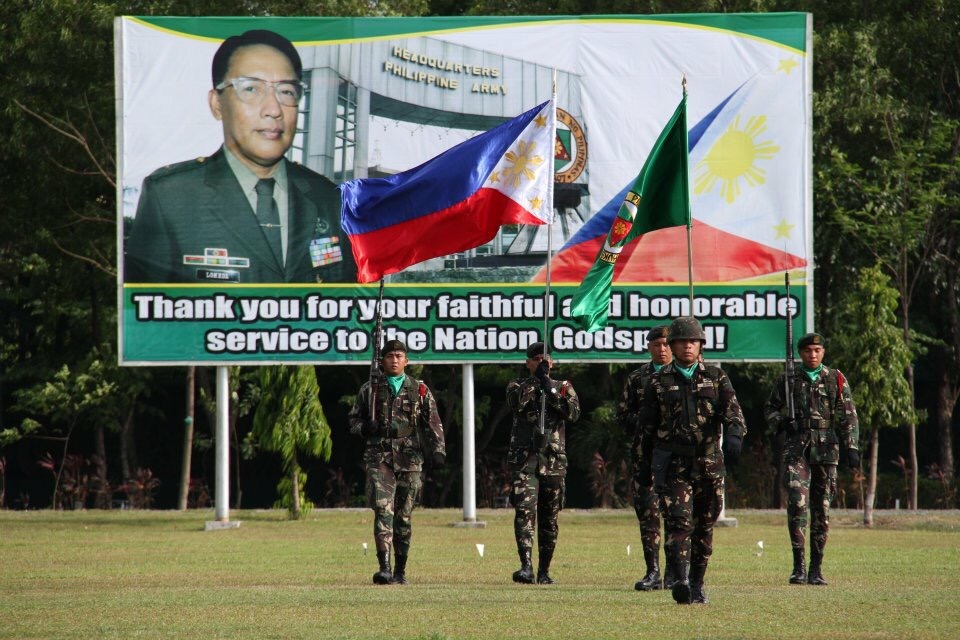
Postscript: This was my retirement speech during my testimonial parade on 25 May 2012 at PA grandstand/parade ground. All the colonels mentioned above became brigadier generals at GHQ.
 Cyber Arnis