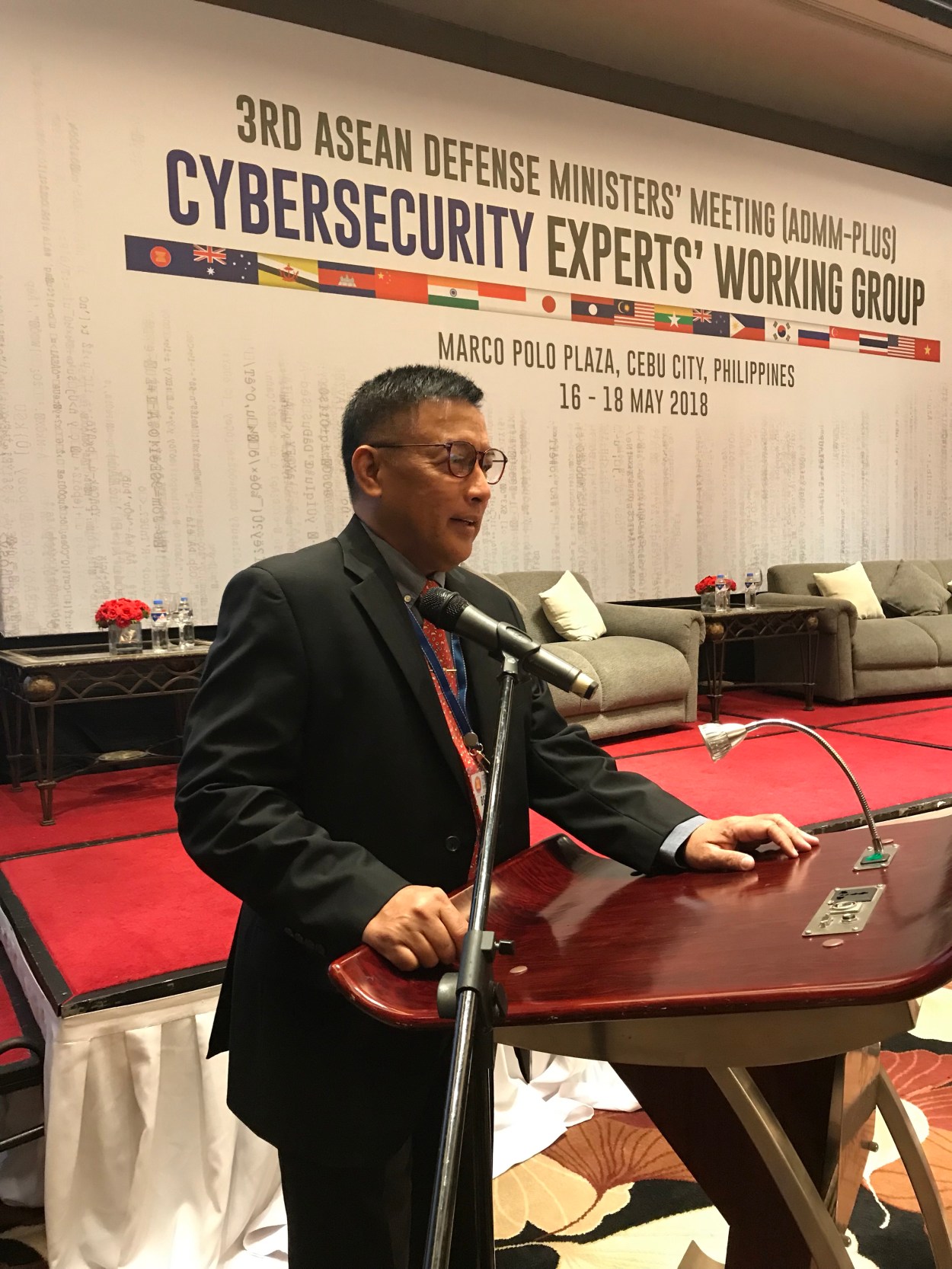
Good Morning! Thank you everybody for coming and joining us here today, in the 3rdADMM+Plus Experts Working Group Meeting. I hope you all had a pleasant trip and were able to relax during the icebreaker cocktail last night while watching the cultural show. In behalf of New Zealand co-chair, Mr. Mike Thompson, both of us are very happy to be co-chairing again and be able to see likewise those of you who have been with us for the 3rd time in a row, as well as those who are new and for the 2ndtime. Also, welcome to Cebu and Marco Polo Hotel! We all know who Marco Polo was but for a brief background of Cebu City. Cebu is known as the “Queen City of the South”. It is one of the most popular jumping off-points for tourists or foreign visitors, with the busiest seaport and the second largest air hub in the Philippines. Everything you have in Manila, you can find them here in Cebu, including the traffic. The dialect here is called Cebuano; talking to the locals in non-cebuano, most people here prefer to speak in English rather than Tagalog, the national language. So please do not hesitate to ask anybody around in English . . .
Last month, I was fortunate to be invited to Malaysia by the ASEAN Regional Forum, or better known as ARF, at the Open Ended Study Group on CBMs, or Confidence Building Measures, to Reduce the Risk of Conflict Stemming from the Uses of Information and Communications Technologies (in short, ICT) and the ARF Inter-Sessional Meeting (ISM) on ICTs Security. Later, the delegate from Malaysia will also update us about the cyber developments over there. I noticed that the developments between our two groups are almost in parallel to what is happening with us now. For me, our group seems to be only a subset of their group. For instance, the Philippine delegation is composed of representatives from different Departments, namely: the Foreign Affairs, Justice and Information and Communications Technology (ICT). The ARF had difficulties in establishing their points-of-contact. They need a database of all agencies involved. Not for us, as I have told them, the real points-of-contact are the Defense Ministers or Secretaries. All points-of-contact that we submitted in our list are directly under their control and supervision, a military-to-military cooperation. Likewise, some of our points-of-contact are already the designated cyber centers that house its Computer Emergency/Incident Response Teams, better known as CERTs or CIRTs. I also mentioned to the ARF about our existing ADI or the ASEAN Direct-Link Infrastructure that was initiated by Brunei. The ADI is the direct telephone hotline amongst the ASEAN Defense Ministries or Secretaries, which is encrypted and secured, not relying on normal Internet infrastructure especially during crisis situations when all systems are down.
For us, ADMM+Plus countries, cybersecurity is not simply reacting to threats but it is about shaping creative and sustainable combinations of technological and social responses at an international level.
During times of crisis, countries need effective communications more than ever; but during tragedies, critical communications failed to make it through congested networks. We must all prepare for international emergencies.
The first step is for countries to be able to communicate reliably during such crisis; but despite existing standards addressing how to do so technically, this ability remains unrealized. We need a glossary of terms, which will remove misunderstanding. So, we will be reviewing the glossary we have in hand for better communication: redefine, add or remove terminologies. With this effort, we can attain common understanding and avoid miscommunications.
To offer immediate solutions to the present impasse, Departments/Ministries of Defense, in charge with the protection of their respective citizens and making cyberspace safer, more stable and more secure is a global challenge, an ADMM+Plus Challenge – one that cannot be solved by a single country, but through cooperation.
The implementation of international standards for handling communications procedures across international borders will provide much needed clarifications about what behavior is appropriate in cyberspace during a catastrophe.
After our consensus, we are now prepared to proceed and practice the communication procedure in tabletop and field exercises next year.
With these developments, we continue to build better confidence, better transparency, better cooperation and ultimately better stability in the region and the world.
Again, welcome to Cebu! Let me now turnover the mic to New Zealand, the co-chair of this meeting, MR. MIKE THOMPSON, for his welcome message . . .
 From Charlie Company