https://dndwebmaster.wixsite.com/darknetworkshop/about
When Ambassador Ma. Theresa Lazaro, the Philippine representative to UNESCO based in Paris, was looking for sponsors to bring the same meeting and speakers here in the Philippines, the Secretary of National Defense (SND) did not hesitate to give a hand! At first he thought, he was going to send people to Paris. He even told me that the Department can send as many as we can afford. I told him it is the other way around and smiling deeply recalling the saying, “If Mohammad can’t go to the mountain, let the mountain come to Mohammad”. With such arrangement, SND is very happy that he is now sending as many as he could . . . only that, sorry, it will no longer be in Paris but only here in Manila!
When the war broke out in Marawi on the 23rd of May last year, there were intelligence reports that foreign fighters were spotted at the city. The reports were proven to be true after identifying the enemy’s dead casualties left behind at the battle area.
One of the suspected casualties is Dr. Mahmud Bin Ahmad, a Malaysian scholar and known to be the financier of the attack in Marawi. According to a July 2017 report by the Jakarta-based Institute for Policy Analysis of Conflict (IPAC), “Mahmud helped facilitate the transfer of funds from ISIS in Syria through Indonesia to the Philippines, where the money was likely used for the preparation of the May 23 attack on Marawi City. The transactions were arranged through the secure messaging app Telegram and money wire transfers on Western Union. According to the report, ISIS channeled $600,000 through Mahmud. Aside from funding, Mahmud also had another key role: recruiting foreign fighters who wanted to join the fighting in Marawi.” This explains the presence of several foreign fighters who heed the call.
According to an article in the Manila Times by Roberto Tiglao, he wrote that the Maute’s in Marawi were expecting to carry a fight similar to what happened in Afghanistan. The jihadist around the world would be sending their fighters to a holy war, reinforcing the Mautes in declaring their caliphate in the region. Thank God! The Philippines has a decisive president, who imposed immediately martial law to quell their desire. The reinforcement was being expected because in Afghanistan, the Philippines sent its share of brave fighters. This allegation can be supported by the report that the MILF, under the leadership of Hashim Salamat, contributed around 1,000 Filipino Muslim fighters to the Afghan war. We can now find these fighters who survived in that war with the battle-weary Abu Sayaff.
The recruitment during that period was through direct human contact and interactions. Internet was just starting by using landlines and modems and not so accessible yet. Perhaps you have heard also about Bin Laden sending his own brother-in-law, Mohammad Jamal Khalifa, to the Philippine to recruit these Filipino fighters.
When Isnilon Hapilon, the leader of the Maute Group and Daesh’s designated emir in Southeast Asia, was killed by the government troops in Marawi, President Duterte declared the following day that Marawi was liberated from terrorist influence; and on the 23rd of that month, SND proudly announced that the 5-month battle against the terrorist in Marawi had finally ended! However, he continued that we should not relax. For the Maute-ISIS terrorists, the battle was won but the war is not yet over. . .
Today, radicals are continuing their fight in cyberspace. The internet now is becoming a key enabler for the ISIS. They are continuing their fight in the cyberspace through propaganda on social networking sites, such as: Facebook, Twitter and YouTube. These developments made US officials warn us of ISIS new caliphate: the cyberspace!
Immediately after the cessation of fighting in Marawi, the Counter-Terrorism Division of the NBI apprehended a certain Karen Aizha Hamidon for recruiting fighters for the Islamic State/Maute group and for spreading radical Islamic propaganda. Hamidon, as reported by the NBI, used messaging applications such as Telegram and WhatsApp to send messages, “calling on Muslims to come to the Philippines and join the fight against government forces in Marawi City in order to assist in establishing the new province of ISIS.”
Then lately, there are reports again last month that 48 foreign terrorists are in Mindanao who are allegedly training local recruits. AFP has monitored the entry of these terrorists from Indonesia, Malaysia and Egypt. So as you can notice, the war against terrorism is really still in progress – a valid reason for extending the martial law in Mindanao . . .
You might wonder now how the bad guys are communicating to choreograph and synchronize their actions?
Previously, they can be found on the surface web utilizing the popular social networking sites, mentioned earlier. There are proofs of online sharing of instructional videos or materials, for instance: you’ve seen the film clip that went on viral about the planning and execution of terrorist attacks by Hapilon and the Maute brothers in Marawi; the frequent beheading of “infidels” infront of a black flag with Arabic inscriptions; construction and detonation of IEDs (improvised explosive devices) and more. Nevertheless, such initiatives are being easily found by foreign and local government anti-terrorist groups. Likewise, leading social media sites have placed measures to prevent the abuse of their platforms. Facebook, Microsoft, YouTube, Google and Twitter recently announced the launch of anti radicalization campaigns. They agreed to remove the offensive messages!
Recent reports suggest that ISIS are now in the deep web. They cannot be easily tracked anymore. They have their own meeting places where they can engage online chat for trafficking of weapons, purchase cyber attack tools (viruses and malware) and recruit would-be terrorists who may act as a lone wolf, assassins or suicide bombers.
The National Cybersecurity Inter-Agency Committee (NCIAC), which is co-chaired by the National Security Adviser (NSA) and the Secretary of the Department of Informations and Communications Technology (DICT), is the one in charge in collating and monitoring these cyber terroristic actions. DND, on the other hand, is in charge of Cyber Defense – the primary organization responsible for countering the threats posed by terrorists’ use of ICT .
So with my recommendation to conduct the workshop, SND was all out support to sponsor and finance this affair offered by DFA; because DND cannot do this fight alone! We need you, the expertise and active support from the private sector and civil society. Online radicalization cannot be tackled by focusing exclusively on attempts to remove content or to restrict access to the Internet. The private sector — particularly the media and the technology sector — possesses a range of tools and resources that could be used to help the government build resilience to radicalization.
In a couple of months, the Department is coming out with a mobile apps called “Alerto” (for both ios and android), an apparatus for us to report to DND’s Cyber Center, the Department Situation Monitoring Center (DSMC), anything that requires DND’s attention. One of this is on the matter of cybersecurity.
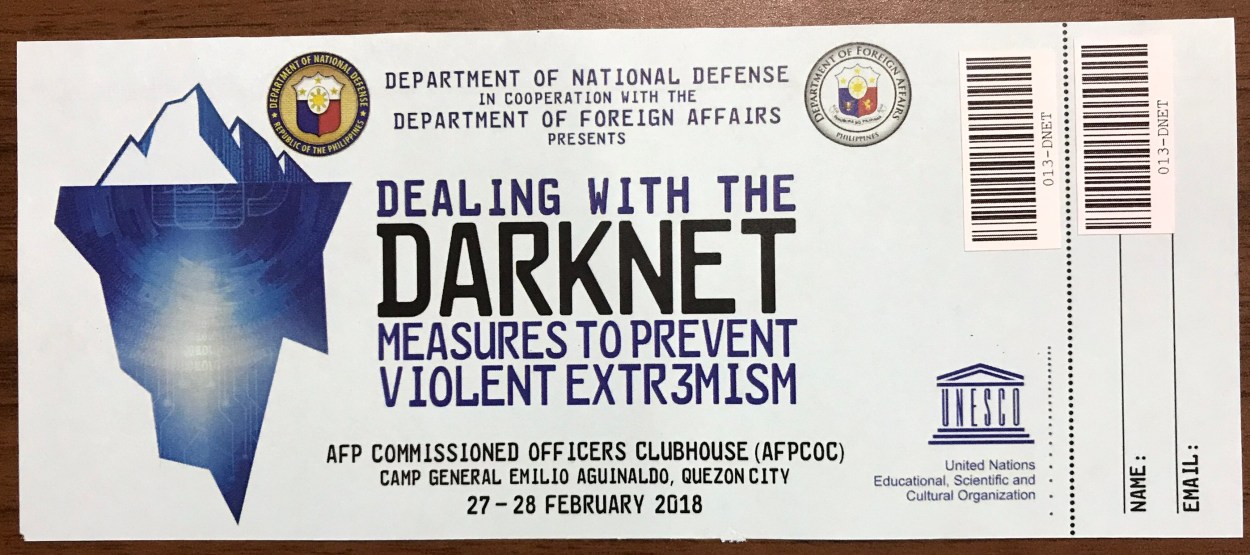
Our success depends on harnessing awareness and knowledge through this kind of forum. So welcome to the workshop on “Dealing with the DarkNet: Measures to Prevent Violent Extremism”. May I also take this opportunity to thank DFA for the partnership and for inviting the subject matter expert speakers from UNESCO to come over to Manila.
May God bless us all and our country, the Philippines!
 Taga Charlie
Very timely and crucial. It’ll serve well on today’s advance technology.
LikeLike
Very good initiative, Sir
LikeLiked by 1 person
Hi sir can i have a free ticket?
LikeLike
DANNY RAMON E. SIONGCO
danny.siongco@yahoo.com
LikeLike
What email address do you wish me to send the eTickets?
LikeLike
pa join din po sir, CSP-CERT member po. thank you in advance!
LikeLike
Sir, I am interested to attend. May I join the workshop sir?
LikeLiked by 1 person
Be meeting with you and G6 this coming week…
LikeLike
Well done Mistah.
LikeLiked by 1 person
Count me in boss!!!
LikeLiked by 1 person
Sir can I attend to this snappy event sir?
LikeLiked by 1 person
BDO-Investigation
LikeLiked by 1 person
I am interested in this. May i join sir?
LikeLike
Permission to join Sir. I’m a former law enforcer and now a private security practitioner. Thanks Sir. -MJ ’01
rudolf.e.mijares@smretail.com
LikeLike
Sure! What email address do you want me to send your free eTicket?
LikeLike
dawang.dave@bdo.com.ph
Thank you sir
LikeLike
Can I join sir.? Im with the Major Crimes Investigation Unit of PNP-CIDG.
LikeLiked by 1 person
Sure! What email address do you want me to send your free eTicket?
LikeLike
suhr, here’s my email: macachor.pnp@gmail.com
LikeLike
Napadala ko na!
LikeLike
Can I Join Sir? Thank you sir. Gadtala ’95
LikeLike
Sure! What email address do you want me to send your free eTicket?
LikeLike
Can I join, sir?
LikeLiked by 1 person
Sure MarQ! Where will I send your free eTicket?
LikeLike
I am very much interested to attend sir.
LikeLiked by 1 person
Report to me! haha
LikeLike
Yes sir
LikeLike
very cool article bok!! really important.
LikeLiked by 3 people
I fully support your effort Bok. Can i join the said workshop? From: PDDG EMELITO T SARMIENTO (Retired). My email add- emilts57@yahoo.com. Ty Bok! Kudos!!
LikeLiked by 1 person
Sure! Sending you your eTicket…
LikeLike