Excerpt from the book: “A Time to Heal – Bloodbath at Pata Island, Sulu”
Still on sale!
February 12, 2022: It has been four decades and a year now, the incident is totally banished in the dustbin history of the AFP. Our memory fading. Nobody can recall anymore the 119 souls who perished in Pata Island on the disastrous day of February 12, 1981, a day before Friday the 13th – being a day of infamy. I was then barely a year old second lieutenant (2LT) at that time, who did everything to save them. Before I wrote the story, I have kept silent about this incident through the years telling no one how it happened? Whenever asked, I had always shied away in narrating the heroism of my companions in 31st Infantry (Charge) Battalion, 1st Infantry (Tabak) Division in our efforts to rescue our besieged comrades. Many members from the battalion who were with me in Pata are dead by now. They have already retired, have been killed-in-action, or have died in sickness. For some reason, I am still alive, healthy (neither crippled nor war-shocked), and doing well as a retiree, something enough to thank God for. Maybe, one reason of my existence tells me that I still have to write a book about the massacre, after all these years…
This is a story not only about the massacre but also the bravery displayed by the men of 31st IB on that fateful day.
FUZZY STORIES
Sometime ago when MGEN ROMEO TOLENTINO’74 was the Chief-of-Staff of the Philippine Army, he had sponsored reunions for Sulu campaign veterans circa 1972-86, comprised especially of retired generals. The night was supposed to be full of singing but instead, the former generals held the microphone talking alternately and repeatedly about Patikul and Pata. I heard retired MGEN EMILIO LUGA JR ’54, who was the Division Commander of Tabak when Pata happened, saying that there was only one survivor.
When blogging in the Internet became my favorite past time at Fort Magsaysay, I joined the Philippine Defense Forum, among other fora. A blogger with a pseudonym “Peso” is asking, “What happened in Pata Island?” All discussants were groping in the dark. They even falsely identified the Philippine Marines as the victims, showing they really know nothing about the topic. So after a while, their discussion shifted to Patikul and Jabidah massacres, which they are more aware of and many stories have been written already about them.
I have used GOOGLE a lot. One time while into it, I tried to google the phrase “Pata Island Massacre”. I was indeed surprised many hits came out. The homepage of the Terrorism Research Center reports, “February 12, 1981: Pata Island Massacre. Moro National Liberation Front (MNLF) insurgents killed 118 government troops on Pata Island after persuading them to lay down their arms”. The Deke’s Diary Special Operations.Com, which records anniversary dates of terrorism incidents all over the world, says: “February 12, 1981, Philippines. Pata Island Massacre, 118 unarmed government troops killed by MNLF”. The website on the Overview of the Moro Struggle through History by Prof Datu Amilusin Jumaani tells us, “In 1981… Marcos lifts martial law (but keeps his dictatorial powers) in a bid to win further legitimacy for his regime. In May, opposition leader Benigno Aguino, released from prison and allowed to go into exile in the US, visits Misuari in Jeddah and promises to support the Tripoli Agreement. MNLF forces kill 120 government soldiers in Pata Island, Jolo. In retaliation, more than 15,000 troops are sent to the island in a massive operation that infuriates Muslim local government officials.”
As Chairman of the Army Training and Doctrine Command (TRADOC) Review Board, I was compelled to give another Battle Review Analysis (BRA) project to 18 students of Officer Preparatory Course (OPC) Class-50, who have been accused of cheating by plagiarism. This time, I made sure that they would not repeat the same offence anymore, by doing a “cut and paste” again. So, I decided to give them a local battle scene that could not be found and downloaded from the Internet. I required them, as a group work, to research on the topic: the Pata Island Massacre. Do you know what? They could not find any story about it anywhere, even in our own PA Historical Archives. Consequently, the group divided themselves by assigning people to go to the Headquarters of 31st IB at Sipocot, Camarines Sur; Headquarters of 1st Infantry Division in Jolo; HPA in Fort Bonifacio; GHQ Library at Camp Aguinaldo; and different newspaper agencies (As I can remember, the story never made the headlines nor the front pages. The news was only a small column in the inside pages and published several days after it happened. I could even recall that some newspapers even reported: 124 government troops killed. (From The Sydney Morning Herald, Thursday February 19, 1981) 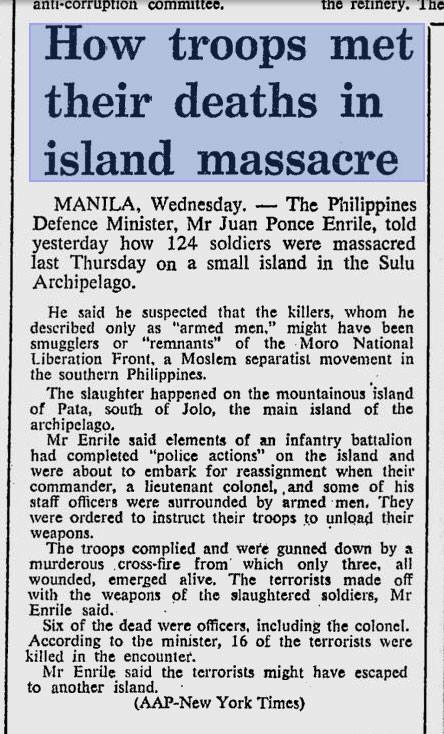 I suspect that there was still censorship at that time because Martial Law was only lifted a month earlier before the massacre happened. President Marcos was determined to picture a stable country to Pope John Paul II, who arrived in Manila on 08 Feb 81 and went on tour around the country. The Pope was one of the many reasons why Martial Law was lifted). Going back to my story, for the students to complete their BRA, they interviewed a retired 2LT from 24th IB, who based his story on hearsay. In the BRA, the students wrote and pointed out that the battalion commander was a Dental Officer, not an infantryman.
LEST WE FORGET!
LTC DENNIS VILLANUEVA ’86 (+) was killed-in-action in Jolo on 10 February last year (http://content.time.com/time/magazine/article/0,9171,1056340,00.html). Upon hearing the news the following day, an eerie feeling crept inside me and realized that the next day would be again the anniversary of the Pata massacre. Then next year will be its silver anniversary!
Pata is an island. It is the second largest island in the Sulu archipelago and only accessible by watercraft. The island served as one of the immediate sanctuary of the MLNF terrorists whenever they met stiff resistance from government forces in the mainland.
MARCHING ORDERS!
In late 1980, there was an intelligence report that members of Civilian Home Defense Force (CHDF) and Special Para-Military Force (SPMF) at Pata were selling their government-issued firearms to a terrorist group.
By January 1981, COL RODOLFO CANIESO ’56, who was the Commanding Officer of 3/1 Brigade, opted to check the report on gunrunning and to account all firearms in Pata Island. The 31st IB, which was due for battalion retraining in Luzon, was tapped for this mission. For the battalion, this would be their last mission before they leave for Fort Magsaysay where the retraining would be held. COL CANIESO assured us by saying, “This will only be just like a picnic!”
At the time the mission was handed down, 31st IB was already under LTC JACINTO SARDUAL (+). He took over on 16 Dec 80 from LTC DANILO OLAY ’65 (+) who was due for the Command and General Staff Course (CGSC) schooling in Australia. On that same month, the new Battalion Commander made me Company Commander of Alfa Company, the first one amongst my classmates to be leading a company.
Accordingly, a Task Force (TF) was created, composed of: Bravo Company under 1LT OSCAR DE VERA, Hotel (P) Company under 1LT PEDRO CAUAN (+) and Alfa Company under me. The turn to be Task Force (TF) Commander fell on 1LT DE VERA. The TF landed on the west side of Pata Island on 05 February 1981 with instructions to proceed eastward.
Our task in Pata was to support the elements of the Special Forces [12Coy, HDFG(A), SWBde]. They would record and register all firearms of the CHDF (Civilian Home Defense Force) and SPMF (Special Para-Military Force). Our rule of engagement was, “not to shoot unless fired upon”. Nonetheless, news in the island had spread already like wildfire that people with firearms would be disarmed; and the firearms registrations were only a ploy.
Echo Company, under 2LT JOEL CAÑARES (+), which was the Training Company of the battalion, was chosen over the more seasoned companies – Charlie and Delta, to serve as security and escort of the Command Group. The trip to Pata would serve as Test Mission for the newly assigned privates, trainees and draftees to the battalion. The Command Group with Echo Company would only be staying safe anyway behind the Task Force. Ultimately on the 7th day, the whole battalion would be pulling out from the island – as easy as it sounds!
SURVIVORS’ ACCOUNT
MSg Edralin Arellano, one of the three survivors, happened coincidentally to be one of my my men at the 7th Signal Battalion in Fort Magsaysay in 2002. During my stint as his Battalion Commander, I never asked him about Pata. I did not like to hear anymore the trauma he suffered. It was only during the time when I decided to write about the incident that I returned and asked him about some details. We compared notes. According to him, LTC SARDUAL and his staff were already making their farewell call on the Barangay officials when they were deceived. A CHDF Commander took LTC SARDUAL surreptitiously as hostage. I learned later that the CHDF Commander was Unad Musillan. He was with MNLF/SPMF Commander Jimang Butoh. The latter was questioning LTC SARDUAL about the intentions and presence of soldiers in the island. In the process of trying to pacify and justify their presence, LTC SARDUAL relayed to them that they meant no harm. In order to prove his intentions and as a sign of good gesture, he would order his men to remove their magazines and empty their rifles. When the order was given, the privates, trainees and draftees, while still in formation, obeyed so. Those old-timers with higher ranks were very suspicious and distrustful.
Soon after the order was given but not before everyone could unload their rifles, an intense volume of gunfire came from every direction killing most of the members of the outfit instantaneously. Msg Arellano, who was still a Trainee, leaped instantly into the pit near the mosque to take cover. In the process, he got hit at his left thigh and shoulder. Many bodies fell on top of him as he played dead. He smelled gasoline. After almost like an eternity, he sensed later the enemy scampering away when mortar firing started dropping near their location.
But before the “peace talk”, 2LT CAÑARES disengaged from the group together with his radioman and some of his Assistant Instructors. He was able to radio us what was brewing. His pack together with those soldiers who were late in removing their magazines put up a fight. They were able to inflict casualties from the enemy.
STANDING TO ITS MOTTO & BATTLECRY
At the time the massacre was happening around 0900H, the Task Force was about to move out from vicinity Timudas (GC 004443) by 3 temper boats belonging to the Seaborne Brigade (these temper boats were wooden Viking-like fishing boats converted into a mini “warships” equipped with caliber .50 and .30 machineguns. Each of them had pumpboats, being pulled by ropes, used for deployment of passengers ashore. The Army’s Seaborne Brigade was under COL JAIME ECHEVERRIA ’57. Our group would be heading vicinity Likud (GC 986407) for the scheduled rendezvous with our Command Group, as our seven-day mission would be terminated at 1200H. We were about to leave already…
Before departing Timudas, 2LT EMMANUEL GONGORA, my Deputy/Ex-O who was serving as platoon leader under me, heard over our PRC 77 radio the anxiety of 2LTCAÑARES regarding disputes between the Command Group and the CHDF/SPMF. Suddenly, radio transmission was cut off. After several attempts of calling back 2LTCAÑARES, my Platoon Sergeant Peñera Paji, with his sullen face blurted, “Oh my god, they are all dead!” I was quick to retort and could not imagine, “That’s not possible! How can you kill them all, at an instant?”
I suggested reinforcing by land but the TF Commander opted to go by sea. He said that the enemy might be waiting to ambush us and it would take us longer to walk 5 to 7 kms in tactical condition in unfamiliar terrain. For me, I was thinking that we could fight better on soil rather than coming from the sea.
Troops were shuttled by pumpboats in boarding the 3 temper boats, one temper per company. Along the way, radioman Private Damaso Calayan fell overboard due to violent waves. In order to save himself and his radio, he let go his rifle losing it to the deep blue sea. At about 1200H with vicinity Likud in sight, I was tasked to lead the expeditionary forces composed of 4 pumpboats with 8-person capacity load each to go ashore; but as we went nearer, we were fired upon by undetermined number of enemy hiding behind barricades. The situation made us sail back to the sea; and as we moved sideways, they kept on blocking our approach. Surveying the area, I decided to unload the troops on a small piece of corral island more than 300 meters away from the beachhead. It was still high tide. COL CANIESO, who was able to reach immediately the scene by speedboat coming from nearby Patian Island, took over in directing the troops and advised us by megaphone to assault simultaneously but to wait for low tide, remaining troops on board the tempers were hauled down to the corrals. The enemy was firing on us. We planned for a Marine-type offensive attack.
When the water was ebbing, the small corral island became bigger and bigger and the gap closer to the beachhead. At 1500H, we heard COL CANIESO shouting through his megaphone, “31st this is the right time!” The tide had turned to its minimum height but we could still see water infront of us. After ten rounds of 60mm mortar bombardment of the proposed entry site by our mortar squad together along with us at the corrals, Alfa Company on the left and Hotel Company at the right facing the beachhead prepared for attack. Bravo Company would be staying behind as Reserve. Somebody at the back shouted our battlecry, “CHARGE!” but everybody reacted with hesitations. We all knew death was upon us! It would be suicide! As I looked behind, all eyes were on me. Thinking, we had to hurry up! I do not know until now what came into me but my prayers at that moment were total submission to God. I kept on praying the Act of Contrition over and over again, asking forgiveness for my sins, as we ran in intermittent zigzag towards the beachhead. Private First Class (PFC) Mariano Reyes, who was near me, was very protective. He kept on pulling me down every time he heard bullets whizzing. I scolded him to stop doing so because I was starting to lose my nerve. Whenever I happened to look back, I could see my men falling down to the ground. I pleaded very deeply from Him to protect them. I did not know that my men were . . . (to be continued)
WHEN YOU BUY THIS BOOK, “A TIME TO HEAL” AND KNOW THE COMPLETE STORY!
FOR SALE AT THE AFP MUSEUM, Camp Aguinaldo, Quezon City (Telephone number: +632 8912 7664)
 Taga Charlie
Alejandro Hornido Estomo 4:24pm Sep 29, 2015
Yes because the Pata Massacre was a historical one. It cannot be simply forgotten, only that so few has known its real story, until you write this detailed narrative . . And you contributed in that memorable incident, especially in the recovery phase, the role of a savior , which was outstanding . I admired what you had done as I appreciated others too , for I know very well that not all had dared to do so . ., that selfless sacrifice given the same situation . . ., you were just too lucky to survive , for others didn’t . . In critical actions between life and death in a battlefield , the outcome is always unknown to us . Only God knows . . But you gambled for the unknown, hence for my salute! You are a great soldier ! May The Lord bless you more. . For your survival there was a blessing by itself . .
LikeLike
before this massacre. my grandfather 2nd LT. efren lumbera is the CO in 1979 that time whom leader unad surrendered
LikeLike
This is a good read . Specially the “invented story” of that guy in the paper bill who delivered a speech in jeddah to get support and sympathy from moslem countries
Feb 13, 2018
LikeLiked by 1 person
The Washington’s Post
“Democracy Dies in Darkness “
Killings Embitter Philippine Moslem Revolt
By Ab Tan
March 31, 1981
Efforts to settle, a festering Moslem rebellion against this country’s authoritarian Christian government have suffered a drastic setback because of a Moslem murder of 122 Philippine Army soldiers on nearby Pata Island and a military retaliation to avenge their deaths.
The latest chapter in the bloody conflict has stalemated the efforts of President Ferdinand Marcos’ government to end the Libyan-backed secession. According to the president, the conflict has claimed more than 60,000 lives since it broke out in 1972 and has tied down a third of the Philippine Army.
The incidents last month, Moslem leaders here predict, will only intensify their agitation for self-rule. Moslems make up 6 percent of the 48 million predominantly Christian Filipinos. They are the country’s largest minority and complain that the Christian majority has long discriminated against their areas.
Independent observers agree that development efforts have failed to transcend cultural suspicions between Moslems and Christians, which have festered through centuries of neglect in the Spanish and American colonial eras. As a result, the southern Philippines remains economically depressed and has the lowest literacy rate in the country.
Marcos’ attempts to bring in the Islamic Conference as mediator foundered when Libya’s pan-Islamic leader, Col. Muammar Qaddafi, forged with Marcos the 1976 Tripoli agreement. This was to provide limited autonomy for the 13 Moslem provinces in Mindanao Island. But the Middle East-based Moro National Liberation Front, which is spearheading the rebellion with an estimated 22,000 guerrillas, rejected two toothless regional autonomous governments that Marcos set up in 1979 and a cease-fire collapsed.
Moslems and the military are blaming each other for events that led to the Feb. 4 massacre. But the fact that the massacre occurred is not contested. According to the Defense Ministry, a lieutenant colonel lured into a trap and held at gunpoint by the rebels ordered his men to unload their guns. The soldiers were then mowed down and some were beheaded or mutilated before their corpses were burned in what probably was the most bloody incident in the Mindanao secession effort, according to the ministry.
In the Army’s strong retaliation, the rebels have so far lost 49 men, including their leader, Cmdr. Meas Unad, according to official count. Ground forces launched large-scale search missions and the Air Force bombarded Pata, the small coral island southwest of Mindanao where the massacre occurred, in the far-flung Sulu Archipelago 95 miles southwest of here.
The bombing ceased early this month and ground fighting also is winding down, according to the Southern Command, the military arm in Mindanao.
But the fighting on Pata Island, by all accounts, already could turn out to have been as destructive as earlier rounds on other islands, particularly to civilians. Nearly 7,000 civilians, half Pata’s population, were caught in the crossfire and have been evacuated to safe centers on the island. Against a background of food shortages, the first cases of malaria and stomach ailments have been reported by officials of the regional autonomous government.
The full death toll from bombing and strafing by the Air Force could not be determined. The government keeps a tight lid on all information from the area. But the Southern Command chief, Brig. Gen. Delfin Castro, was quoted as saying it is inevitable that many civilians get killed in an operation of Pata’s scale.
The island has been blockaded and all boats and fishing vessels were either destroyed or seized, Southern Command officials said.
A ranking leader of the Tausugs, the warlike Moslem tribe of the Sulu group, who recently visited the Pata evacuees said: “There was fear and anger in their eyes. The indiscriminate shooting has hardened the feelings of the Tausugs.”
“It has made it difficult for us to persuade the people to vote yes in the April 7 plebiscite,” he continued, referring to a referendum in which Marcos seeks to amend the constitution so he can run for president again next June.
This leader, who asked not to be identified, said he considered the retaliation operations unwise because within days of the massacre, the estimated 300 rebels on Pata had escaped in five speedboats in the direction of the Malaysian state of Sabah, where the rebels often normally seek sanctuary.
Another Moslem leader, Sharif Zain Jali, a teacher of Islamic law, has gone to mosques in Zamboanga City to agitate the Moslems to “sharpen their bolos,” according to a top government official referring to local curved knives.
In an interview, the Cairo-educated Jali declared: “We are no longer safe. I Told everybody in the mosques to be prepared to defend themselves. I told them not to surrender their arms.”
Another Sulu leaders, Kalbi Tupay, a former rebel commander and now a member of parliament urged the president to pull troops out of Pata because, he said, their presence is provocative.
Part of the issue now is a feeling by many Moslems that government-appointed Moslem leaders have chosen not to probe too deeply into grievances.
The autonomous government of western Mindanao, for example, sent a fact-finding team to Pata who weeks ago to investigate charges of military abuses as the reasons for the anger leading to the massacre. The leader of the team and speaker of the local assembly, Nur Ututalum, on his return vehemently denied the allegations, saying the evacuees told him there were no abuses by soldiers before the massacre.
Jali, who claimed many of his relatives in Pata have been killed, said bitterly: “They couldn’t tell the truth because of the Army.”
LikeLiked by 1 person
Good Lord GOD, how brave those soldiers were and how untrustworthy these rebels are. I can’t recall the exact date where Gen. Bautista (was it?) was also lured to his death by treacherous act of yes sadly, another muslim rebel. It only shows that since time immemorial they have this penchant to trick government forces into goodwill for them to easily prick them we no or very little resistance. Can we blame then for the actions (revenge) by some of our soldiers? When will this end? Like the dead Yassir Arafat, MISUARI can never be trusted. When will another incident of this magnitude happen again for us to realize the sad reality?
For all the fallen soldiers, you have my greatest admiration and respect. May your soul RWST IN PEACE and may GOD BLESS YOU ALL.
LikeLiked by 1 person