Ghost writer: J. Irving
Good day to all my fellow Disaster Risk Reduction and Management (DRRM) practitioners.
I am Professor Dante D. Balao, a retired Regional Director of the Office of Civil Defense (OCD) Region II. I retired in September 2020 after serving as Regional Director from 2016 to 2020. Today, I am a faculty member at the College of Forestry and Environmental Management of Isabela State University – Kabagan Campus, where I teach Disaster Risk Reduction and Management and Climate Change Adaptation.
With that brief introduction, let me share with you an advocacy that has been close to my heart. I developed this concept in 2020—an idea that seeks to automate Disaster Risk Reduction and Management (DRRM) to assist our local chief executives, from the highest levels of government down to the barangay.
At first glance, this concept may seem ambitious—even impossible. But history has taught us that many of humanity’s greatest achievements once appeared impossible.
Allow me to tell you a story.
On July 20, 1969, the world witnessed one of its greatest milestones when Neil Armstrong became the first human being to walk on the Moon. The Apollo 11 mission consisted of three astronauts: Neil Armstrong, the mission commander; Buzz Aldrin, the Lunar Module pilot; and Michael Collins, the Command Module pilot.
As Armstrong stepped onto the lunar surface, he uttered the immortal words:
“That’s one small step for man, one giant leap for mankind.”
A few minutes later, Buzz Aldrin joined him on the Moon.
But after completing their mission and returning to the Lunar Module, Armstrong reportedly said something that puzzled many people:
“Good luck, Mr. Gorsky.”
At that time, the United States and the Soviet Union were locked in the famous Space Race. The Soviet Union had already achieved several milestones, including sending Yuri Gagarin, the first human to orbit the Earth. Because of this rivalry, many people wondered if “Mr. Gorsky” was perhaps a Soviet scientist or cosmonaut.
When the astronauts returned to Earth, reporters immediately asked Armstrong:
“Who is Mr. Gorsky?”
He refused to answer.
For years—through countless interviews and public appearances—the question followed him. Yet he remained silent.
Finally, about 25 years later, in 1994, Armstrong decided to tell the story.
He recalled that in 1939, when he was about eight or nine years old, he loved playing baseball. One day, he hit the ball so hard that it landed in the yard of their neighbors.
As he went over to retrieve it, he overheard a heated conversation between a beautiful young woman and a rather persistent suitor. The man was pleading with her to accept his marriage proposal, but she repeatedly refused.
Growing impatient with his relentless persistence, she finally exclaimed:
“Fine! I’ll marry you when that mischievous little boy next door walks on the Moon!”
That mischievous little boy… was Neil Armstrong.
Thirty years later, in 1969, he fulfilled what had once been considered an impossible dream.
Whether the young couple eventually married or not, Armstrong admitted that he never found out.
That is the story of Mr. Gorsky.
Now, why am I sharing this story with you?
Because in 1939, walking on the Moon was unimaginable. Yet only three decades later, it became reality.
Likewise, what I am about to present today may seem impossible. Some of you may think it is too ambitious or too futuristic. But with time, patience, perseverance, innovation, and commitment, what seems impossible today can become tomorrow’s reality.
This project is grounded on existing Philippine laws and policies, including:
- Republic Act No. 7160 – The Local Government Code;
- Republic Act No. 9729 – The Climate Change Act;
- Republic Act No. 10121 – The Philippine Disaster Risk Reduction and Management Act;
- The Hyogo Framework for Action (2005–2015); and
- The Sendai Framework for Disaster Risk Reduction (2015–2030), together with relevant Joint Memorandum Circulars.
This presentation will compare established DRRM theories with actual conditions on the ground.
The Sendai Framework emphasizes four priorities, the first and perhaps the most important being:
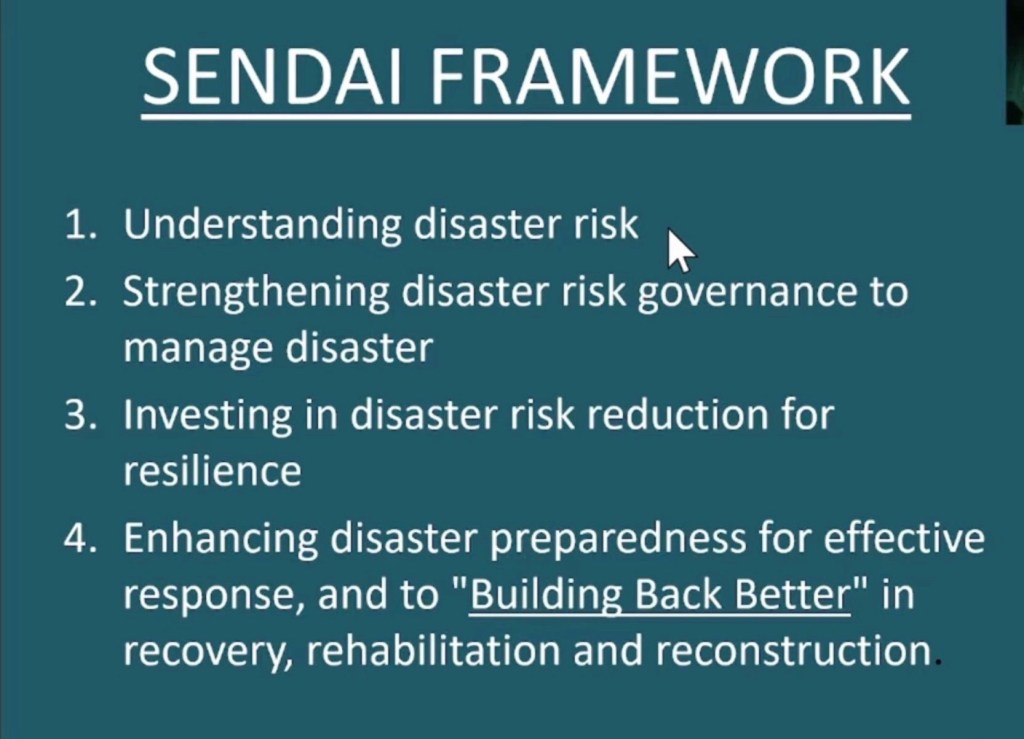
Understanding Disaster Risk.
After all, if we do not fully understand the risks we face, we cannot effectively prepare for or respond to disasters.
Another important principle is “Build Back Better,” which encourages communities not merely to recover after disasters but to emerge stronger and more resilient.
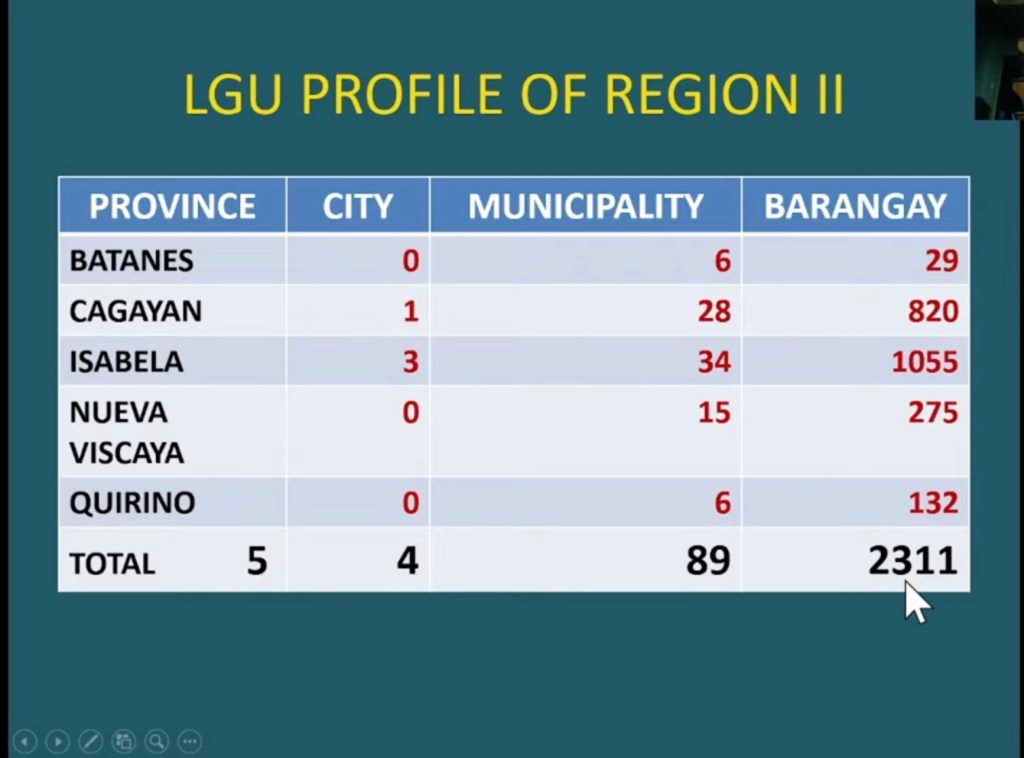
Allow me to provide a brief profile of Region II (Cagayan Valley).
The region consists of:
- Five provinces
- Four cities
- Eighty-nine municipalities
- 2,311 barangays
Among them, Isabela is the largest province, while Batanes is the smallest.
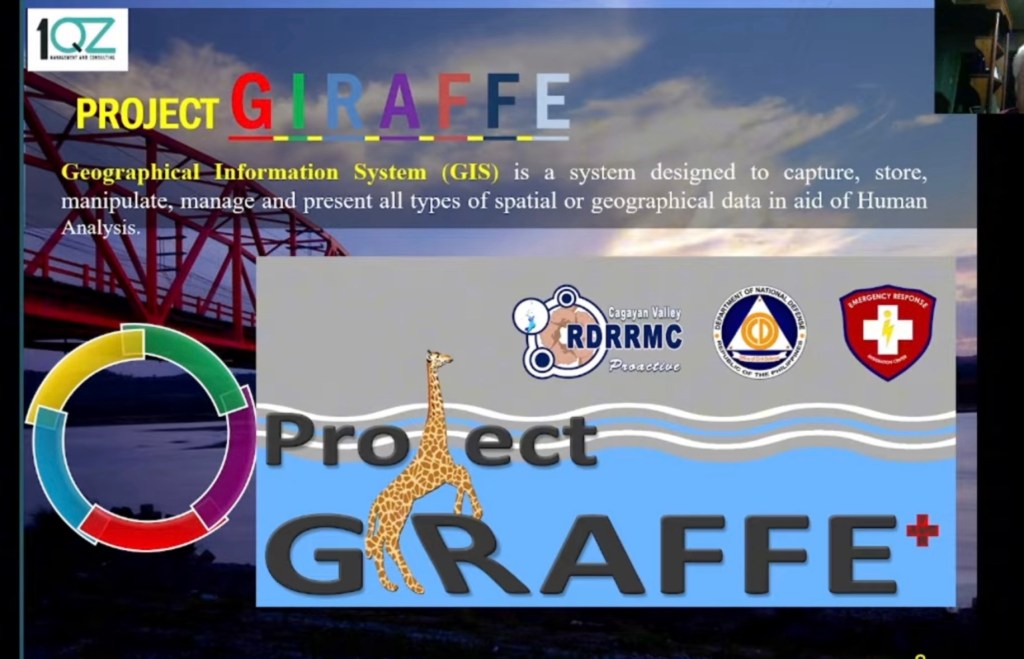
This automation project was developed using Geographic Information System (GIS) technology.
With no government funding available, I recruited talented Information Technology students from Cagayan State University and Isabela State University. They developed the system as part of their on-the-job training (OJT). Their work was entirely pro bono. In return, they received their OJT certification.
I was always selective in accepting OJT students. Every applicant underwent an interview before joining our office because I wanted only committed and capable individuals to become part of the project.
The system uses GIS not only for mapping but also for risk analysis, flood forecasting, and virtually any type of disaster-risk assessment.
My vision was simple:
To create a paperless—or at least paper-light—DRRM system.
Once the baseline data have been entered, the system performs the rest.
Think of it like driving a modern vehicle.
Your dashboard instantly tells you your speed, engine temperature, fuel level, and engine performance. You don’t need to inspect every mechanical component—you simply look at the dashboard.
The same concept applies here.
Our DRRM dashboard presents information in two synchronized panels.
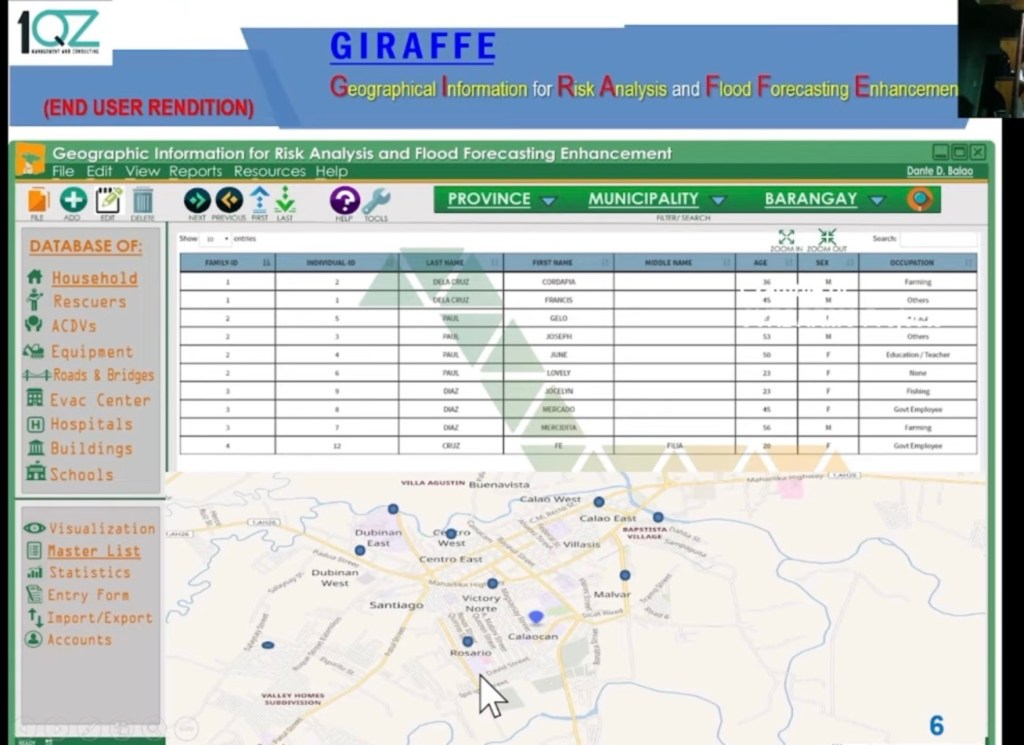
The first panel contains the baseline database, while the second displays graphical visualizations.
Users can simply click on any of Region II’s five provinces, then select a municipality, and finally choose a barangay.
Every selection automatically updates both the graphical presentation and the corresponding database.
The two panels work together seamlessly.
The system begins with household-level baseline data because disaster risk management ultimately revolves around protecting people.
From there, it can visualize trends, generate projections, and provide decision-makers with a clear picture of what is happening within their areas of responsibility.
In our next session, I will demonstrate how this automated DRRM dashboard actually works and showcase examples of what it can do.
I encourage you to watch the next presentation, where you will see how dashboard technology can transform disaster risk reduction and management into a faster, smarter, and more data-driven process.
Please feel free to leave your comments, ask questions, or contact me through my Facebook Messenger.
Thank you very much for your time and attention.
I look forward to seeing you in our next session.

